1. Overview
Hinami Fueguchi is one of Tokyo Ghoul's most emotionally resonant characters, a young ghoul whose innocence stands in stark contrast to the brutal world she inhabits. Introduced as a shy, traumatized child who has just lost both parents to the CCG's ghoul investigators, Hinami becomes a ward of the Anteiku coffee shop family, growing under the protection of Touka Kirishima and Ken Kaneki. Her journey across both the original Tokyo Ghoul and its sequel :re traces the arc of a vulnerable child transforming into a determined young woman capable of protecting those she loves. Hinami represents the series' most poignant exploration of how trauma shapes the young and whether innocence can survive in a world where survival demands violence. Unlike many characters in the series who respond to tragedy with anger and aggression, Hinami's response is quieter but no less powerful. She channels her pain into a resolve to grow stronger, not for revenge but to ensure she never has to watch another loved one die helplessly again. Her Koukaku-type Kagune, the most defensive of the four Kagune types, reflects her personality perfectly: she is a protector by nature, building walls to shield others rather than weapons to harm. By the series' conclusion, Hinami has evolved from a frightened child into among the most stable and capable members of the new ghoul society, her gentle heart intact but now backed by formidable strength and unshakeable determination.
2. Appearance
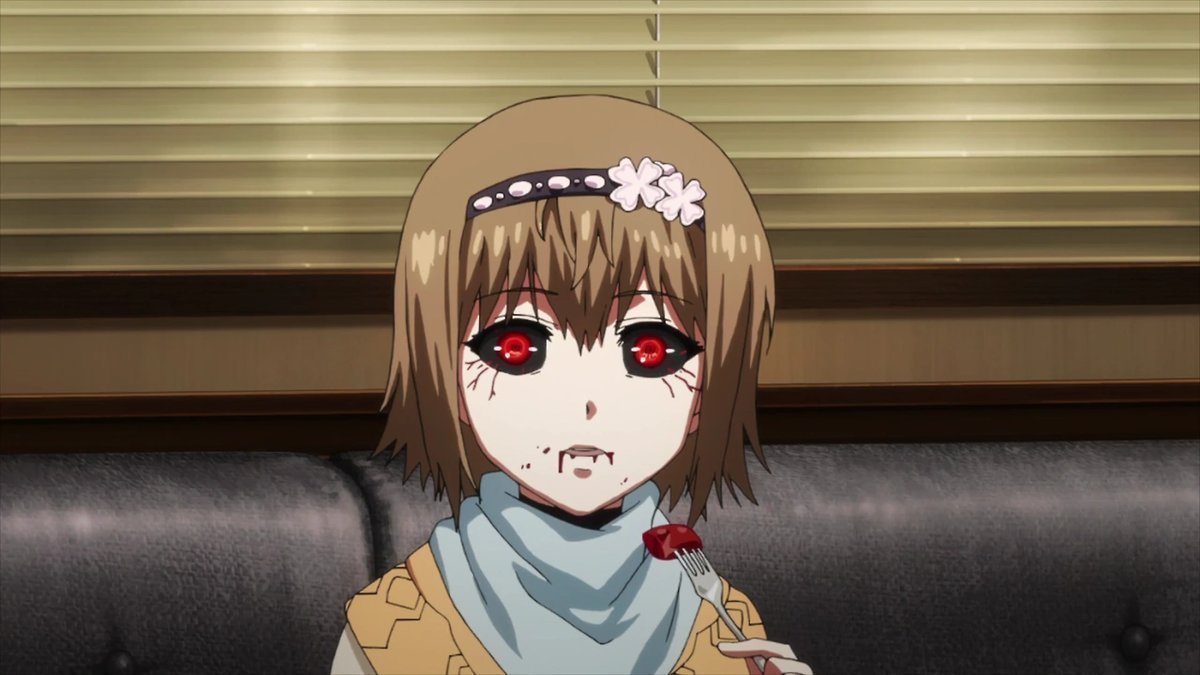
Hinami is introduced as a small, delicate girl with short dark hair and large, expressive brown eyes that reveal every emotion she feels. Her petite frame and youthful features make her appear younger than her actual age, emphasizing her vulnerability in the dangerous world of Tokyo Ghoul. In the original series, she wears simple, modest clothing befitting a child: school uniforms, casual dresses in muted colors, and practical footwear. Her appearance is intentionally unassuming, helping her blend in with human children despite being a ghoul. When her kakugan activates, her eyes shift to a deep crimson with black sclera, a stark transformation that highlights the duality of her nature as both an innocent child and a predatory ghoul. Her Koukaku Kagune manifests as armored plating and crystalline shell-like formations that emerge from her shoulders and back, typically in shades of deep purple and black. Unlike the flashy wings of Ukaku users or the tentacles of Rinkaku users, her Kagune's defensive appearance reflects her protective personality.
As Hinami grows older in Tokyo Ghoul:re, her appearance matures significantly. She becomes a tall, elegant young woman with long dark hair that she often wears in a ponytail or loose style. Her features harden slightly, carrying the confidence of someone who has faced her fears and survived. She adopts more practical, combat-ready clothing, though she retains a sense of feminine style that reflects her gentle nature. Her Kagune also evolves, becoming more refined and controlled, the crystalline plates forming with greater precision and strength. The contrast between her child self and her adult appearance is striking, visually representing the incredible journey she has undertaken. Despite her growth, her eyes retain their characteristic warmth, signaling that her kind heart has survived the trials she has endured. Her appearance in the later series is a testament to her resilience: she has grown taller, stronger, and more capable, but the gentle soul that defined her childhood remains visible in her expressions and demeanor.
3. Personality
Hinami Fueguchi's personality is defined by an extraordinary capacity for gentleness in a world that gives her every reason to become bitter and vengeful. After witnessing her mother's murder by CCG investigator Kureo Mado, Hinami could have easily followed the path of many ghouls toward hatred and violence. Instead, she channels her grief into a quiet but fierce determination to protect the family she has left. Her defining trait is her gratitude. Having lost everything once, she treasures every relationship with an intensity that drives her actions. She is deeply appreciative of Touka's protection, Kaneki's kindness, and Yoshimura's wisdom, and her primary motivation throughout the series is to become strong enough to repay their care by protecting them in turn. This desire to protect others, rather than to harm enemies, distinguishes Hinami from most other fighters in the series.
Hinami is naturally shy and soft-spoken, particularly in the early series where trauma has made her hesitant and withdrawn. She speaks in quiet, polite tones and is careful not to burden others with her problems. However, she possesses a core of steel that becomes more apparent as she grows. When those she loves are threatened, her shyness falls away, replaced by focused determination. She is also remarkably perceptive for her age, able to read the emotional states of those around her and respond with appropriate support. Her love of learning, encouraged by Kaneki's example, expands her worldview and gives her hope that understanding between humans and ghouls might be possible. As she matures, Hinami develops into a confident and capable young woman who can lead when necessary, but she never loses her fundamental kindness. She represents the possibility that one can experience tragedy and emerge not hardened and bitter, but strengthened and more compassionate. Her personality arc is a quiet counterpoint to the series' louder, more dramatic character journeys, proving that strength comes in many forms, including the courage to remain gentle in a cruel world.
4. Abilities
Hinami possesses a Koukaku-type Kagune, the most defense-oriented of the four primary Kagune classifications. Koukaku Kagune are characterized by dense, armor-like structures that provide excellent defensive capability at the cost of reduced mobility. Unlike the Ukaku's emphasis on speed or the Rinkaku's focus on raw power, the Koukaku is built for endurance and protection. Hinami's Kagune manifests as crystalline shell-like plates that emerge from her upper back and shoulders, forming a protective barrier around her body. These plates are extremely durable, capable of withstanding sustained attacks from other ghouls and Quinque weapons. In the early series, her control is limited to simple defensive formations, but as she matures, she develops the ability to shape her Kagune into more complex structures, including shields that can cover multiple people and offensive implements like armored fists or bludgeons.
Hinami's combat style reflects her protective personality. She excels at drawing enemy attention and absorbing damage that would otherwise harm her allies. Her Koukaku's durability allows her to fight as a frontline defender, creating openings for faster, more offensively oriented teammates. As she gains experience, she learns to maintain her Kagune for extended periods, compensating for the Koukaku's traditionally high RC cell consumption through rigorous training and mental discipline. In Tokyo Ghoul:re, Hinami's abilities have grown considerably. She demonstrates the capacity to extend her Kagune beyond simple armor, creating larger defensive barriers that can protect multiple people simultaneously. Her offensive capabilities have also improved, as she can now shape her Kagune plates into sharp-edged weapons for counter-attacks. Her agility, while not matching Ukaku users, has improved to the point where she can maintain effective combat mobility despite her Kagune's weight. Hinami's true strength, however, lies not in raw power but in her tactical awareness and unwavering resolve. She fights smarter than most opponents, using her defensive abilities to control the battlefield and protect her allies while waiting for strategic opportunities to strike. Her growth from a helpless child to a reliable combatant who can stand alongside veteran fighters is one of the series' most satisfying character developments.
5. Story Arcs
Hinami is introduced in the early chapters of Tokyo Ghoul as a young ghoul whose mother, Ryoko Fueguchi, has been targeted by CCG investigator Kureo Mado. Despite their desperate attempts to escape, Mado corners and kills Ryoko in front of Hinami, an event that traumatizes the child and sets the course for her entire character arc. Kaneki and Touka arrive too late to save Ryoko but rescue Hinami, bringing her to Anteiku where she becomes part of their found family. In the aftermath of her mother's death, Hinami is withdrawn and fearful, but the kindness of Kaneki, Touka, and Yoshimura slowly draws her out of her shell. She forms particularly close bonds with Touka, who becomes a big sister figure, and Kaneki, who encourages her love of reading and learning. The Aogiri Tree arc tests Hinami's resolve as she watches the people she loves march into danger. She begins training in secret, determined to become strong enough to protect others rather than always being the one who needs protection.
During the Anteiku Raid, Hinami's growth becomes apparent. She participates in the defense of Anteiku, fighting alongside Touka and Tsukiyama against the CCG invasion force. She holds her own against experienced investigators, demonstrating that her training has paid off. However, the raid results in the destruction of Anteiku, the capture of Yoshimura, and Kaneki's apparent death. Hinami is forced to flee and rebuild her life once again, losing her second family. In Tokyo Ghoul:re, Hinami has grown into a capable young woman. She continues to operate as part of the ghoul resistance, protecting other ghouls and gathering information. Her reunion with Kaneki, now living as Haise Sasaki, is emotionally complex. She recognizes him immediately but respects his need to rediscover his identity at his own pace. When Kaneki reclaims his memories and declares himself the One-Eyed King, Hinami is among his most loyal supporters. She participates in the Rue Island operation and later in the battles against the CCG's Oggai squad. Her combat prowess has matured to the point where she can face high-tier opponents effectively. In the final arcs, Hinami plays a vital role in protecting the civilian ghoul population during the chaos of the Dragon disaster. She survives the series, having fulfilled her childhood wish to become strong enough to protect those she loves. Her journey from a traumatized orphan to a confident, capable young woman is one of the series' most uplifting storylines, proving that even in Tokyo Ghoul's dark world, growth and healing are possible.
6. Relationships
Hinami's relationship with Touka Kirishima is the most formative of her young life. After Hinami's mother is killed, Touka takes on the role of older sister, protecting Hinami, teaching her about ghoul society, and providing emotional support during her grief. Initially, Touka is awkward in this role, unsure how to care for a traumatized child when she herself is still dealing with her own losses. But their bond deepens over time, with Hinami's gentle nature softening Touka's rough edges and Touka's fierce protectiveness giving Hinami a sense of safety. By :re, their relationship has evolved into one of mutual respect and support, with Hinami no longer just the protected but also a protector who can watch Touka's back in combat.
Her bond with Ken Kaneki is equally significant. Kaneki treats Hinami with genuine warmth and intellectual respect, encouraging her curiosity and love of reading. He becomes a big brother figure who introduces her to the world of literature and ideas, expanding her understanding of what life could be beyond mere survival. Hinami, in turn, becomes one of the few characters who believes in Kaneki unconditionally, never wavering even when he loses his memories or transforms into the Dragon. Her faith in him is a constant source of strength, and their reunion in :re is one of the series' most touching moments. Hinami's relationship with Yoshimura, the manager of Anteiku, provides her with the wisdom and guidance of a grandfather figure. Yoshimura's philosophy of peaceful coexistence and his belief that ghouls and humans can find common ground deeply influence Hinami's worldview. His loss during the Anteiku Raid is a devastating blow, but the values he instilled in her continue to guide her actions. Finally, Hinami's unresolved trauma regarding her mother's death at Kureo Mado's hands shapes her early character. Unlike many revenge-driven characters, Hinami does not allow this trauma to consume her with hatred. Instead, it transforms into a determination to ensure that no other child has to experience the same loss. This mature response to tragedy defines her character and makes her one of the series' most emotionally intelligent figures.
7. Cultural Impact
Hinami Fueguchi holds a special place in Tokyo Ghoul fandom as the character who embodies the series' emotional heart. In a story filled with monstrous transformations, psychological horror, and moral ambiguity, Hinami represents innocence and the possibility of preserving goodness in the face of overwhelming darkness. Her presence provides emotional balance to the narrative, giving readers a character to root for whose motivations are purely protective rather than vengeful or self-serving. Her popularity stems from her relatability as a child navigating a world she did not choose, much like the series' central theme of forced transformation. Fans appreciate her quiet strength and the way she grows into her power without losing her essential kindness, a narrative choice that distinguishes Tokyo Ghoul from darker series where innocence is inevitably crushed by the narrative's cynicism.
Her Koukaku Kagune design, with its crystalline purple armor plates, has been a favorite among cosplayers and fan artists, offering a visually distinctive alternative to the more commonly depicted Ukaku and Rinkaku types. Her character design evolution from child to young adult in :re is frequently praised as one of the series' best visual representations of character growth. Academically, Hinami has been discussed in analyses of trauma representation in manga, particularly how children process violence and loss in fictional narratives. Her refusal to become a vengeful character despite suffering profound loss offers a counter-narrative to the typical "trauma creates monsters" trope common in dark fantasy. In broader anime culture, Hinami is often cited in discussions of well-written child characters in seinen manga. Unlike many child characters who exist solely as motivation for adult protagonists or as comic relief, Hinami has her own agency, growth arc, and meaningful contributions to the plot. She demonstrates that child characters can be complex, capable, and emotionally resonant without sacrificing their youth or innocence. Her journey from a frightened orphan whispering "I want to protect" to a young woman who actually can protect her loved ones remains one of the series' most emotionally satisfying arcs.
8. FAQ
What happened to Hinami's parents in Tokyo Ghoul?
Both of Hinami's parents were killed by CCG investigators. Her father was killed before the series begins, and her mother Ryoko Fueguchi is murdered in front of Hinami's eyes by CCG investigator Kureo Mado. This traumatic event defines Hinami's early character and motivates her determination to become strong enough to protect her new found family at Anteiku from suffering the same fate.
What type of Kagune does Hinami have and how does she use it?
Hinami has a Koukaku-type Kagune that manifests as crystalline armor plates on her upper back and shoulders. Koukaku are the most defensive Kagune type, optimized for protection rather than speed or range. She uses her Kagune to create durable shields and barriers that can withstand heavy attacks, and as she matures, she learns to shape it into offensive implements like armored fists for counter-attacks.
How does Hinami change between Tokyo Ghoul and :re?
Hinami undergoes significant growth between the two series. In the original Tokyo Ghoul, she is a shy, traumatized child who relies on others for protection. By :re, she has matured into a tall, confident young woman who can fight effectively and protect others. She maintains her gentle nature but now backs it with formidable combat abilities and unshakeable determination.
Does Hinami survive the events of Tokyo Ghoul:re?
Yes, Hinami survives :re and is present at the series' conclusion. Having fulfilled her childhood wish to become strong enough to protect those she loves, she continues to live as part of the new ghoul society, her gentle heart intact but now backed by the strength and confidence she spent years developing.
What is Hinami's relationship with Touka and Kaneki?
Hinami views Touka as an older sister figure and Kaneki as a big brother. Touka protects and mentors Hinami after her mother's death, while Kaneki encourages her love of reading and intellectual growth. Both relationships are central to Hinami's development, providing her with the emotional support and guidance she needs to grow from a traumatized child into a capable young woman.