1. Overview
Yoshimura is the kind-hearted manager of the Anteiku coffee shop and one of Tokyo Ghoul's most morally complex characters. On the surface, he is a gentle elderly man who runs a peaceful coffee shop in the 20th ward, providing a safe haven for ghouls seeking a quiet life away from the violence of the ghoul world. Beneath this warm exterior lies a shocking truth: Yoshimura was once the legendary "One-Eyed Owl," an SSS-rated ghoul whose battles with the CCG became the stuff of legend. His past as a brutal fighter stands in stark contrast to the peaceful philosopher he becomes, and his journey from violence to pacifism forms an essential part of the series' thematic exploration of redemption and coexistence. Yoshimura serves as a father figure to many young ghouls, including Touka Kirishima and Ken Kaneki, guiding them with wisdom earned through centuries of life experience. His philosophy of non-violence and peaceful coexistence between humans and ghouls represents the moral ideal of the series, even as events force him to confront his violent past. His relationship with his daughter Eto Yoshimura adds layers of tragedy to his story, as his sins as a father mirror the broader failures of both human and ghoul societies.
2. Appearance
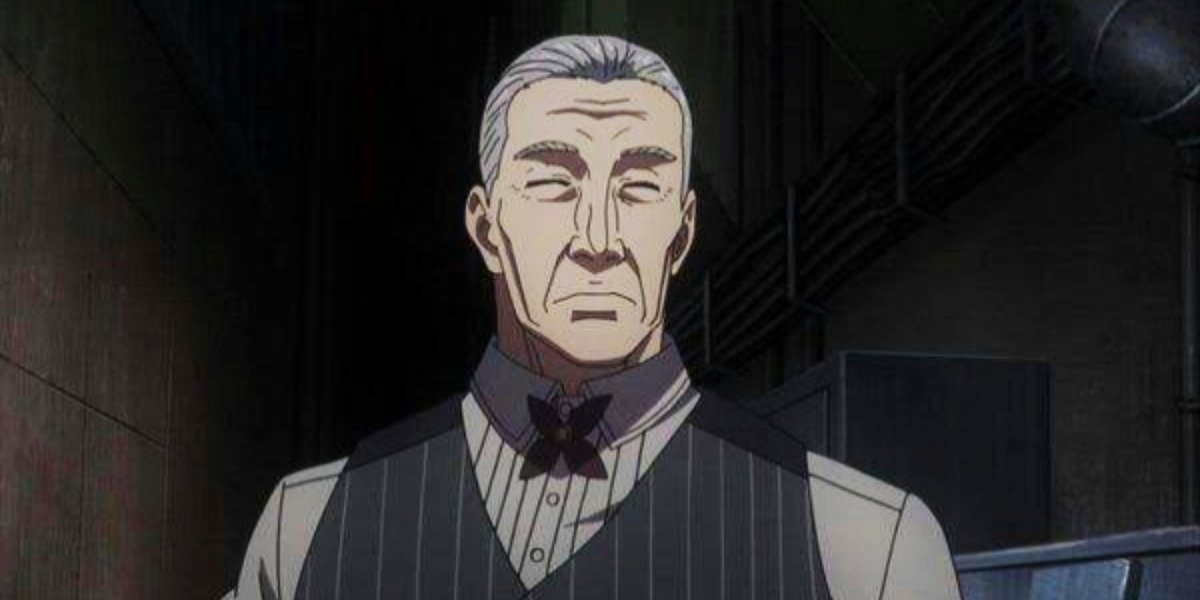
In his daily life as Anteiku's manager, Yoshimura presents the image of a kindly elderly gentleman. He has gray hair combed neatly, warm eyes behind round glasses, and a gentle smile that puts everyone around him at ease. He stands at an average height with a modest build, and his posture is slightly stooped with age, making him appear unassuming and harmless. He typically wears a simple white apron over casual clothes — a brown vest over a long-sleeved shirt — the uniform of a coffee shop manager who cares more about comfort and practicality than fashion. His face is lined with wrinkles earned through centuries of living, and his expression is perpetually calm and welcoming. When he moves, there is a deliberate slowness to his gestures that suggests patience rather than frailty. His hands, though aged and spotted, move with the precision of someone who has spent decades perfecting the art of coffee brewing.
When Yoshimura reveals his true nature as the One-Eyed Owl, his appearance transforms into something terrifying. His body expands and distorts, his Kagune erupting from his back in the form of enormous Ukaku wings that can blot out the sky. His face shifts into a bestial mask, and his eyes glow with crimson light. The Owl form is massive, easily four or five times the size of a normal human, with Kagune feathers that can launch as projectiles and wings that generate devastating shockwaves. This transformation is a complete inversion of his gentle Anteiku appearance: where the manager is small and warm, the Owl is enormous and terrifying. The contrast between his two forms encapsulates his character — a man who has rejected violence but cannot escape the monster he was created to be. In :re flashbacks, we see a younger Yoshimura, before age softened his features, and even then there is a sadness in his eyes that speaks to the weight of his past.
3. Personality
Yoshimura's personality is defined by wisdom earned through suffering and a genuine commitment to peace. As the Anteiku manager, he is gentle, patient, and deeply compassionate, always willing to listen to the problems of the ghouls who seek refuge in his shop. He offers advice without judgment, support without conditions, and creates an atmosphere of safety that allows ghouls like Touka and Kaneki to feel human despite their monstrous nature. His philosophy of coexistence is not naive idealism but hard-won conviction. Having lived for centuries and witnessed countless cycles of violence, he concludes that the only path forward is peaceful coexistence, even if it seems impossible. He teaches Kaneki that strength is not about fighting power but about the courage to protect what matters. Yoshimura's patience is legendary — he endures provocations, insults, and threats without losing his composure, believing that anger only feeds the cycle of violence.
Beneath his gentle exterior, Yoshimura carries immense guilt and regret. His past as the One-Eyed Owl haunts him, and his complicated relationship with his daughter Eto is a source of deep pain. He abandoned her when she was young, a decision made to protect her that instead left her alone and resentful. This failure as a father is the central tragedy of his life. He is willing to sacrifice himself for his beliefs, as demonstrated during the Anteiku Raid when he surrenders to the CCG to protect his patrons. Yoshimura's personality represents the series' ideal of what a ghoul can aspire to be — not a monster defined by hunger, but a person defined by choices. His commitment to non-violence is tested repeatedly, and when he does fight, it is always in defense of others rather than aggression. He embodies the possibility of redemption, showing that even someone with a past as violent as the One-Eyed Owl can choose a different path.
4. Abilities
As the One-Eyed Owl, Yoshimura possesses among the most powerful Ukaku Kagune in Tokyo Ghoul history. Unlike standard Ukaku-types that fire small crystal projectiles, Yoshimura's Kagune manifests as enormous wings capable of generating devastating shockwaves with each beat. His Ukaku is classified as SSS-rated, placing it at the highest known threat level alongside ghouls like Eto and Noro. The wings can launch countless feather-like projectiles that home in on targets with devastating accuracy, and their sheer size allows Yoshimura to dominate aerial combat in ways that few ghouls can match. His regeneration is among the fastest in the series, allowing him to recover from wounds that would incapacitate or kill most ghouls. Centuries of combat experience have honed his instincts to a razor edge, and he reads opponents with the ease of someone who has seen every trick in the book.
Yoshimura's true power, however, lies in his control. Unlike younger ghouls who rely on raw aggression, Yoshimura fights with economy of motion and perfect timing. He uses exactly the force needed to achieve his objectives, conserving energy for prolonged engagements. His Ukaku Kagune is particularly dangerous at medium to long range, where his feather projectiles can rain down destruction while keeping him out of melee range. In close combat, he uses his wings as both shield and bludgeon, their Kagune composition making them harder than steel. Yoshimura's kakuja form, the full One-Eyed Owl transformation, increases his size and power dramatically, though he rarely uses it due to its psychological toll. According to Fandom Wiki documentation, Yoshimura fought the CCG's most powerful investigators to standstills on multiple occasions, earning his SSS rating through demonstrated superiority in combat. His decision to retire from violence is not weakness but choice — he remains among the most dangerous beings in the Tokyo Ghoul universe until his final battle during the Anteiku Raid.
5. Story Arcs
Yoshimura's story spans the entire Tokyo Ghoul narrative, though much of his past is revealed through flashbacks and exposition. In the original Tokyo Ghoul, he is introduced as the warm, welcoming manager of Anteiku who takes in Kaneki after his transformation and teaches him to control his ghoul instincts. His role in the early series is that of a wise mentor, guiding Kaneki through the complexities of ghoul society with patience and insight. He explains the structure of the CCG, the nature of Kagune, and the importance of finding a community that accepts you for who you are. The Anteiku Raid arc brings Yoshimura's past crashing into the present. When the CCG launches a full-scale assault on Anteiku, Yoshimura reveals himself as the One-Eyed Owl to protect his patrons. His battle against Kishou Arima is one of the original series' most spectacular confrontations, pitting the legendary ghoul against the legendary investigator.
Despite his power, Yoshimura is defeated and captured by the CCG. His surrender is a conscious choice — he holds back to minimize casualties and accepts his fate to protect the young ghouls who looked up to him. The aftermath of his capture reverberates through the series, as his absence leaves a void in the ghoul community and drives much of Kaneki's motivation in :re. In Tokyo Ghoul:re, Yoshimura's legacy looms large. His daughter Eto carries his complicated legacy, and the truth about his past as a member of the V Organization and his relationship with the Washuu family adds layers to the series' political complexity. His captivity in Cochlea prison is a recurring element in :re's narrative, and his eventual fate — dying in prison after years of containment — is a quiet, undignified end for a once-terrifying legend. Yoshimura's story is a meditation on the cycle of violence: a man who escapes his bloody past only to be dragged back into it, paying the ultimate price for sins committed centuries ago.
6. Relationships
Yoshimura's most significant and painful relationship is with his daughter, Eto Yoshimura. Eto is the product of Yoshimura's relationship with a human woman, making her a natural one-eyed ghoul — the only one of her kind. Yoshimura loved his daughter deeply, but circumstances forced him to abandon her when she was young, leaving her to be raised by the cruel orphanage director Kaiko. This abandonment shaped Eto into the vengeful, manipulative figure she becomes, and her resentment toward her father fuels much of her actions. Their relationship is the series' most tragic parent-child dynamic, a story of good intentions leading to catastrophic outcomes. Yoshimura's relationship with Ken Kaneki is that of a surrogate father and son. Yoshimura takes Kaneki in after his transformation, teaches him to survive as a half-ghoul, and shares his philosophy of peaceful coexistence. Kaneki becomes the heir to Yoshimura's ideals, continuing the fight for coexistence after the manager's fall.
His relationship with Touka Kirishima is similarly paternal. Yoshimura employs Touka at Anteiku and provides her with stability after her family's destruction. He is patient with her rebellious nature and guides her toward a path of peace rather than revenge. Touka's growth into a responsible adult is a testament to Yoshimura's influence. His relationship with Kishou Arima is complex and layered. As the CCG's strongest investigator and the V Organization's enforcer, Arima is Yoshimura's natural enemy. Yet both men understand that they are playing roles in a larger system neither controls. Their battle during the Anteiku Raid carries undertones of mutual respect between warriors who recognize each other's skill and burden. Yoshimura's relationship with the V Organization and the Washuu family is one of obligation and resentment. He served them in his violent youth and carries guilt for the atrocities he committed on their behalf. His retirement to Anteiku was an attempt to escape their influence, but the past is never truly past in Tokyo Ghoul.
7. Cultural Impact
Yoshimura holds a distinctive place in the Tokyo Ghoul fandom as the series' moral compass and a symbol of the possibility of redemption. His philosophy of peaceful coexistence between humans and ghouls is frequently cited by fans as the series' central message, and his character is often discussed in analyses of Tokyo Ghoul's ethical framework. The contrast between his gentle manager persona and his terrifying Owl form has made him a memorable figure in anime character design, illustrating the series' theme that appearances are deceiving and that monstrosity is a matter of behavior, not biology. Yoshimura's coffee shop Anteiku has become iconic in its own right, representing a sanctuary of peace in the violent world of Tokyo Ghoul. The image of Yoshimura behind the counter, brewing coffee and dispensing wisdom, is one of the series' most enduring visual motifs.
In cosplay communities, Yoshimura's two forms offer distinct options: the simple apron and glasses of the manager is a subtle, recognizable cosplay choice, while the full One-Eyed Owl transformation is an elaborate challenge for experienced costume makers. Yoshimura's relationship with Eto has been analyzed in discussions of parent-child dynamics in dark anime, praised for its realistic portrayal of how even well-intentioned parental decisions can cause lasting trauma. His line about "those who win battles we know nothing about" is frequently quoted as a summary of the series' philosophy about hidden strength and quiet resilience. On MyAnimeList and similar platforms, Yoshimura is respected as a well-written mentor figure who subverts the typical "wise old master" trope by having a genuinely dark past that he must reckon with. His legacy extends beyond Tokyo Ghoul as an example of how anime characters can embody moral complexity — not pure good or pure evil, but someone who has done terrible things and chosen to become better.
8. FAQ
Is Yoshimura the One-Eyed Owl from Tokyo Ghoul?
Yes, Yoshimura is the original One-Eyed Owl, an SSS-rated Ukaku-type ghoul whose battles with the CCG became legendary. He later abandoned his violent past to become the peaceful manager of Anteiku coffee shop, where he provided sanctuary for ghouls seeking to escape the cycle of violence and live peacefully.
What happened to Yoshimura at the end of the original Tokyo Ghoul?
During the Anteiku Raid, Yoshimura revealed himself as the One-Eyed Owl to protect his patrons. He fought Kishou Arima in a spectacular battle but was defeated and captured by the CCG. He was imprisoned in Cochlea, where he remained until his death during the events of Tokyo Ghoul:re, dying in captivity.
Is Eto Yoshimura related to the Anteiku manager?
Yes, Eto Yoshimura is the biological daughter of Yoshimura and a human woman, making her a natural one-eyed ghoul. Yoshimura abandoned her as a child to protect her from the V Organization, a decision that caused lasting trauma and resentment. Eto's actions throughout the series are heavily influenced by this abandonment.
What is Yoshimura's Kagune type?
Yoshimura possesses an Ukaku Kagune, which manifests as enormous wings capable of launching devastating feather projectiles and generating shockwaves. His Kagune is classified as SSS-rated, the highest threat level in the Tokyo Ghoul universe, making him among the most powerful ghouls in the series' history.
Why did Yoshimura stop fighting as the One-Eyed Owl?
Yoshimura abandoned his identity as the One-Eyed Owl after centuries of violence because he came to believe that fighting only perpetuated the cycle of hatred between humans and ghouls. He chose instead to create a sanctuary where ghouls could live peacefully, dedicating his remaining years to proving that coexistence was possible through Anteiku.