1. Overview
Eto Yoshimura is one of Tokyo Ghoul's most complex and influential characters, a figure who operates at the intersection of literature, terrorism, and ghoul liberation. She exists under two radically different identities: Sen Takatsuki, the bestselling horror novelist whose dark, philosophical works captivate readers including Kaneki himself, and the One-Eyed Owl, an SS-rated ghoul of terrifying power who serves as the spiritual leader of the violent ghoul organization Aogiri Tree. Born as a natural one-eyed ghoul, the daughter of the peace-seeking Yoshimura and a human woman, Eto embodies the tension between her parents' opposing philosophies. Her father believes in peaceful coexistence between humans and ghouls; her mother's tragic death convinces her that such coexistence is impossible and that only through radical violence can ghouls achieve liberation. This ideological conflict drives her actions throughout the series, making her simultaneously one of its most sympathetic and most terrifying figures. Eto manipulates events from behind the scenes, orchestrating Kaneki's transformation into the One-Eyed King, engineering the CCG's destruction from within, and forcing the world to confront the reality of ghoul existence through catastrophic violence. Her character represents the series' darkest philosophical currents, exploring questions about whether the ends justify the means, whether violence can ever produce lasting peace, and whether those who have been broken by the world have any obligation to spare it from their pain.
2. Appearance
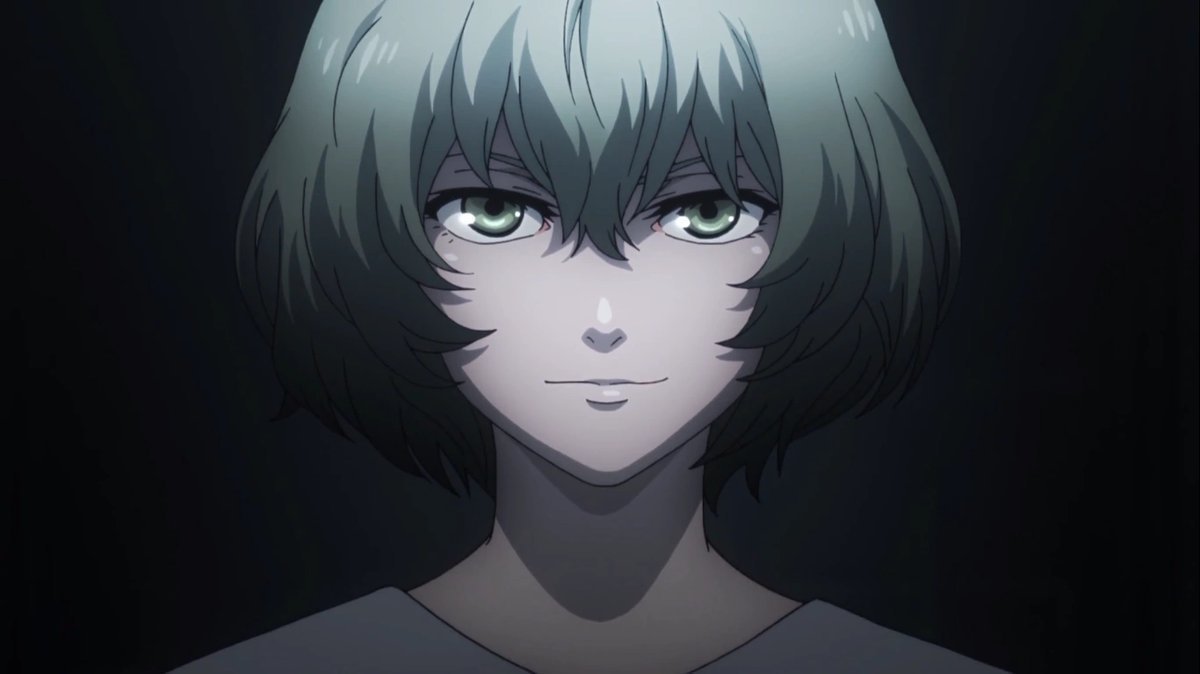
Eto's appearance is defined by her dual identities, each with a distinct visual presentation. As Sen Takatsuki, the renowned author, she appears as an elegant young woman with long, dark hair, intelligent eyes, and a fragile, almost delicate build. She dresses in sophisticated, gothic-inspired clothing that reflects her literary persona, favoring black dresses, lace accessories, and artistic jewelry. Her public appearance is designed to be unassuming and approachable, allowing her to move freely through human society without attracting suspicion. When her ghoul nature manifests, her eyes shift to the characteristic crimson ghoul eye with black sclera, and her gentle expression hardens into something far more predatory. Her transformation into the One-Eyed Owl is one of the series' most visually striking sequences. Her body expands into a massive, nightmarish entity with multiple wings composed of Kagune, a skeletal face, and an aura of pure destructive power. The Owl form is colossal, capable of leveling buildings and shrugging off attacks that would destroy lesser ghouls.
The contrast between Eto's human form and her Owl form is central to her character's visual impact. In her human guise, she is small, beautiful, and intellectually compelling, the kind of person one might meet at a book signing. In her ghoul form, she is a monster of apocalyptic proportions, a living weapon of mass destruction. This duality reflects the series' central question about the nature of monsters and whether they are born or created. Throughout the series, Eto shifts between these forms with increasing ease, often maintaining her human appearance while planning destruction on a massive scale. In :re, after her defeat and imprisonment by the CCG, Eto's appearance becomes more haggard and worn, reflecting her physical and psychological exhaustion. She retains her sharp intelligence, but the toll of her battles and her confinement shows in her features. Her design throughout the series communicates her fundamental nature: a woman of immense intellect and even greater destructive power, whose gentle exterior hides a being capable of reshaping the world through violence.
3. Personality
Eto Yoshimura is defined by a profound and corrosive nihilism that masks a deep well of pain and a genuine, if twisted, desire for a better world. She views existence through a lens of残酷 beauty, believing that truth can only be found through suffering and that the world must be destroyed before it can be rebuilt. Her philosophy is not merely an intellectual position but a deeply felt response to her own traumatic history: born as a natural one-eyed ghoul, rejected by human society, raised in isolation, and witness to her mother's gruesome death in front of her father's eyes. These experiences convinced her that kindness is weakness, that the system is irredeemably corrupt, and that only through catastrophic violence can ghouls ever achieve freedom. As Sen Takatsuki, Eto is articulate, charming, and intellectually stimulating. She writes novels that explore themes of pain, identity, and monstrousness, works that resonate deeply with readers like Kaneki who are struggling with their own dual natures. Her literary success demonstrates her intelligence, creativity, and understanding of human psychology. She uses her author platform to spread her philosophy subtly, planting seeds of doubt and questioning in the minds of her readers.
However, behind this intellectual facade lies a deeply damaged individual who has substituted ideology for genuine emotional connection. Eto is incapable of forming healthy relationships because she has never experienced them. Her father's distance, her mother's death, and her isolated upbringing left her with no model for trust or love. She manipulates people because she does not know how to connect with them any other way. Her treatment of Kaneki is particularly complex: she genuinely sees his potential as a symbol for ghoul liberation, but she also seems to feel a twisted form of kinship with him as a fellow one-eyed ghoul. Whether this kinship is genuine affection or just another manipulation is left deliberately ambiguous. As the series progresses, particularly after her defeat and imprisonment, Eto's nihilism begins to crack. Facing her own mortality and the failure of her grand plans, she shows glimmers of vulnerability and even regret. Her final scenes suggest that she may have believed in her cause more than she was willing to admit, and that her cynicism was at least partly a defense against hope. Eto is, in the end, a tragic figure, a woman whose intelligence and vision could have built something beautiful if her circumstances had been different, but who instead chose destruction because she could not imagine any other path.
4. Abilities
Eto Yoshimura possesses among the most powerful and versatile Kagune in all of Tokyo Ghoul, a rare hybrid that combines Ukaku and Rinkaku characteristics. Natural one-eyed ghouls are extremely rare, and Eto's hybrid Kagune reflects her unique biology. Her Ukaku component manifests as massive wings capable of both flight and long-range projectile attacks, firing crystalline shards at devastating speeds. Her Rinkaku component adds powerful tentacle-like appendages that can strike with crushing force over extended range. This dual Kagune type makes Eto effective at any combat distance, able to engage enemies with ranged attacks, close-quarters strikes, and aerial mobility. In her Owl form, these abilities are amplified to apocalyptic levels. Her wings become large enough to blot out the sun, her projectiles can shred reinforced CCG armor, and her regenerative capabilities allow her to recover from wounds that would kill any normal ghoul almost instantly. The Owl form is classified as an SS-rate threat by the CCG, one of the highest danger ratings ever assigned.
Beyond her raw physical power, Eto's greatest weapon is her intellect. She is a strategic genius who thinks across years and decades, not days and weeks. Her manipulation of Kaneki, the CCG, Aogiri Tree, and virtually every other faction in the series demonstrates her ability to orchestrate complex machinations with multiple moving parts. She gathers information through her literary career, her ghoul connections, and her network of informants, giving her a comprehensive understanding of both human and ghoul societies. Her knowledge of CCG operations, Quinque technology, and ghoul biology is encyclopedic, allowing her to develop countermeasures for virtually any threat. In combat, Eto combines her overwhelming physical power with tactical intelligence. She does not simply overwhelm opponents with brute force but analyzes their fighting styles, exploits their weaknesses, and adapts her approach as needed. She is patient when necessary, willing to retreat and regroup if the tactical situation demands it, and she never fights without purpose. Even when apparently defeated, Eto often has contingency plans in place that her enemies have not anticipated. Her combination of physical power, strategic intelligence, and psychological insight makes her arguably the most dangerous single character in the series, a threat that cannot be neutralized through combat alone because her influence extends far beyond her personal fighting ability.
5. Story Arcs
Eto's presence is felt throughout Tokyo Ghoul long before she appears in person. As Sen Takatsuki, her novels provide a philosophical framework that Kaneki and others use to interpret their experiences. The themes of her books, pain, transformation, and the nature of monsters, directly parallel the series' central concerns. Eto is first referenced as the author of "The Black Goat's Egg" and other works that Kaneki deeply admires, establishing her intellectual influence before her physical introduction. Her first direct appearance in the original Tokyo Ghoul comes during the Aogiri Tree arc, where she briefly reveals her ghoul nature while manipulating events behind the scenes. Her full power is displayed during the Anteiku Raid, where she appears as the One-Eyed Owl and battles Kishou Arima to a standstill, demonstrating her terrifying capabilities. This confrontation establishes Eto as among the most powerful beings in the series, a force that even the legendary Arima cannot easily defeat.
In Tokyo Ghoul:re, Eto's role expands dramatically. She orchestrates the Cochlea prison break, freeing Kaneki and other powerful ghouls while revealing the truth about Arima and the CCG's corruption to the world. She anoints Kaneki as the One-Eyed King, giving him her vision for ghoul liberation while manipulating him toward her own ends. Her relationship with Kaneki during this period is ambiguous, alternating between genuine mentorship and calculated manipulation. The Rue Island operation sees Eto fighting alongside Kaneki's forces against the CCG, her power proving decisive in several key engagements. However, her true plan is more complex than simple victory in battle. Eto wants to create a situation where the world can no longer ignore the ghoul question, forcing a resolution that will finally address the fundamental injustice of ghoul existence. Her capture by the CCG is revealed to be partially intentional, part of a larger scheme to expose the corruption within the organization. From her prison cell, Eto continues to manipulate events, writing a new novel that reveals classified information about the CCG's crimes and ghoul experimentation. This act of literary terrorism demonstrates her commitment to her cause and her belief in the power of ideas alongside the power of violence. In the Dragon arc, Eto makes a final, fateful decision. She helps Kaneki accept his Dragon transformation, knowing it may mean her own death, because she believes this catastrophic event will finally force humanity and ghouls to confront each other honestly. She fades from the narrative after this point, her ultimate fate left ambiguous. Whether she dies, escapes, or simply stops participating is never explicitly confirmed, an appropriate end for a character who always operated from the shadows, influencing events without ever being fully visible.
6. Relationships
Eto's relationship with her father Yoshimura is the foundational tragedy of her life. Yoshimura, the gentle manager of Anteiku, loved Eto's human mother deeply, but his inability to protect her from the CCG's persecution left Eto orphaned and bitter. Yoshimura's philosophy of peaceful coexistence, while noble, felt like betrayal to Eto, who saw it as passive acceptance of ghoul oppression. Their ideological conflict mirrors the series' central debate: is violent revolution justified against an unjust system, or does peace require compromise and patience? Eto and Yoshimura never reconcile, their estrangement representing the generational trauma that haunts the ghoul community. Despite their differences, Eto's actions are arguably motivated by a desire to prove her father wrong, to show that his gentle approach was doomed to fail and that only her path of violence can achieve real change.
Her relationship with Ken Kaneki is the most complex and consequential in the series. Eto sees in Kaneki a kindred spirit, a fellow one-eyed ghoul who bridges the divide between human and monster. She manipulates him throughout both series, pushing him toward accepting his ghoul nature and taking on the mantle of the One-Eyed King. Yet their relationship contains elements of genuine mentorship and even affection. Eto provides Kaneki with philosophical guidance, pushes him to grow stronger, and sacrifices herself for his cause. Whether this constitutes genuine care or is simply the final stage of her manipulation is deliberately ambiguous, adding depth to both characters. Eto's relationship with Kishou Arima is one of mutual respect and opposition. They are the two most powerful beings in the Tokyo Ghoul world, natural enemies destined to clash. Their duel during the Anteiku Raid is one of the series' most spectacular battles, a confrontation between the CCG's greatest weapon and the ghoul world's most dangerous force. Yet there is a strange understanding between them, both recognizing the other as a worthy opponent in a conflict that neither can fully control. Her relationship with Aogiri Tree is purely instrumental. She uses the organization as a tool for her larger plans but has no loyalty to it or its members. She is not truly a leader in the conventional sense but a force that moves through the organization, directing its energy toward her own ends. This detachment from personal connections is both her greatest strength and her deepest flaw, allowing her to make hard decisions without emotional interference but leaving her alone in the end.
7. Cultural Impact
Eto Yoshimura occupies a unique position in Tokyo Ghoul fandom as the series' most intellectually formidable antagonist, a character whose influence extends far beyond her physical power. Her dual identity as Sen Takatsuki, the author whose works provide the series' philosophical backbone, makes her a meta-textual figure who comments on the nature of storytelling itself. Fans and critics have noted the parallel between Takatsuki's novels and Tokyo Ghoul as a work of fiction, with Eto's themes of monstrousness and identity reflecting the series' own concerns. This self-referential quality has made Eto a favorite subject of literary analysis within anime criticism, with scholars examining her character as a commentary on authorship, influence, and the relationship between creators and their creations.
Her visual design, both as the elegant Sen Takatsuki and the terrifying One-Eyed Owl, has become iconic in anime culture. The Owl form, with its skeletal visage and massive wings, is among the most recognizable monster designs in modern anime, influencing subsequent depictions of winged antagonists in dark fantasy series. Eto's philosophical monologues about pain, truth, and the nature of the world are frequently quoted and analyzed, contributing to Tokyo Ghoul's reputation as a series that engages seriously with existential questions. In broader anime discourse, Eto is often discussed as an example of a well-written female antagonist in a medium that sometimes struggles to give female villains the same complexity as their male counterparts. Her intelligence, agency, and philosophical depth set a standard for female villain writing that influenced later series. Her quote about the world being both cruel and beautiful encapsulates Tokyo Ghoul's tonal balance between horror and hope, and her character remains a benchmark for morally complex antagonists in dark fantasy anime. Eto's legacy in the series is ambiguous, as her methods were extreme but her diagnosis of the system's injustice was largely correct. She forced the world to confront uncomfortable truths and, in her own destructive way, pushed the narrative toward a resolution that might not have been possible without her intervention.
8. FAQ
Why is Eto called the One-Eyed Owl?
Eto is called the One-Eyed Owl because her massive Owl form features wing-like Kagune that resemble an owl's wings and a skeletal face with one visible ghoul eye. The name also references her status as a natural one-eyed ghoul, born with both human and ghoul traits. The "Owl" moniker was given by the CCG to classify her as among the most dangerous SS-rated ghouls in existence.
Is Sen Takatsuki the same person as Eto Yoshimura?
Yes, Sen Takatsuki is Eto Yoshimura's pen name. As Takatsuki, she is a bestselling horror novelist whose dark, philosophical works explore themes of pain, identity, and monstrousness. Her novels are highly influential in the series, with Kaneki being a devoted fan. The dual identity allows Eto to move through human society, spread her philosophy, and gather information without revealing her ghoul nature.
What type of Kagune does Eto have and why is it special?
Eto has a rare hybrid Kagune combining Ukaku and Rinkaku characteristics, reflecting her unique biology as a natural one-eyed ghoul. Her Ukaku wings provide flight and powerful ranged attacks, while her Rinkaku tentacles deliver devastating close-quarters damage. This combination makes her effective at any combat range, and her Owl form amplifies these abilities to apocalyptic levels.
What is Eto's relationship with her father Yoshimura?
Yoshimura is Eto's father, the manager of Anteiku who believes in peaceful ghoul-human coexistence. Eto resents his passive approach, viewing it as acceptance of oppression after her mother was killed by the CCG. Their ideological conflict reflects the series' central debate about whether violent revolution or peaceful compromise is the correct path for ghoul liberation.
Does Eto survive the events of Tokyo Ghoul:re?
Eto's ultimate fate is left ambiguous. She helps Kaneki accept his Dragon transformation during the final arcs, knowing it may cost her life, and she fades from the narrative afterward. Whether she dies, escapes, or simply stops participating is never explicitly confirmed. This open ending is appropriate for a character who always operated from the shadows, influencing events without being fully visible.